
Climate, energy and business decisions
A publication by AME Straticon × BVGE (German)
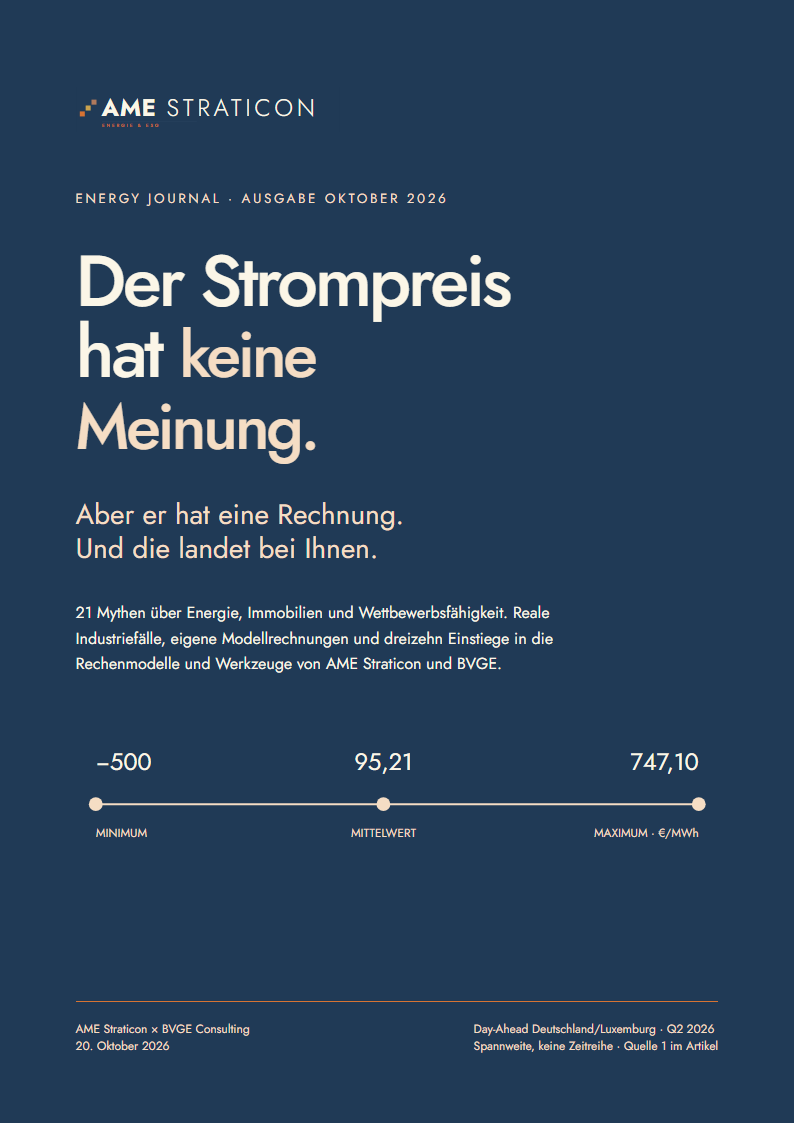
Electricity prices have no opinion.
But they come with a bill. And it lands on your desk.
PDF and complete HTML text without registration. The publication is in German.
Edition · German · PDF 0.68 MB
Start with the energy bill. AME Straticon contributes investment, property and capital perspectives. BVGE contributes procurement, contract checks, metering and operations. Together, we make assumptions and decision limits explicit.
- Myths
- 21
- Sources
- 31
- Tool profiles
- 13
- Pages
- 47
Two perspectives. A shared publication.
AME Straticon
AME Straticon GmbH
Editorial lead and host in the EnergyHub, contributing investment, property, capital allocation, PPA, renovation and CRREM perspectives.
BVGE Consulting
BVGE Deutschland GmbH
Co-author for energy procurement, contract and invoice checks, metering and operational implementation.
Go deeper · Articles from the magazine
Find the question on your desk.
12 articles with their own focus, practical examples and relevant tools. Summaries and decision prompts are in English; the full articles are in German.
The myths in the current magazine
English summaries introduce each chapter. Follow the link for the complete text and sources in the German HTML edition.
- Chapter 01
“Germany will meet its climate targets with ease.”
A target does not become more likely just because it appears in an attractive chart. The German Environment Agency estimates Germany’s emissions in 2025 at 648.9 million tonnes of CO₂ equivalents. Its 2026 projection, using the policy instruments considered, puts the reduction by 2030 at 62.6 per cent compared with 1990; the statutory target is 65 per cent. The projection incorporates information available up to November 2025. Later crises or reforms are therefore not automatically included.
Read the complete chapter and sources (German) - Chapter 02
“The electricity sector will solve the problem on its own.”
A cleaner electricity mix makes a difference in an important part of the system. It does not insulate a roof, install a charging connection or correct poorly controlled process heat. Electrification connects sectors and the work each has to do. That is why the IPCC considers energy supply, infrastructure and demand together.
Read the complete chapter and sources (German) - Chapter 03
“Transport will electrify itself.”
A vehicle does not run on a political declaration of intent. It needs a suitable duty cycle and the right infrastructure. For a fleet, the relevant factors include distance, payload, downtime, charging power, available grid connection capacity and alternatives when plans change. Only then does comparing purchase prices and operating costs become meaningful.
Read the complete chapter and sources (German) - Chapter 04
“Hydrogen will save everything.”
Hydrogen can matter where direct electrification reaches technical or economic limits, or where hydrogen itself is needed as a material input. It requires suitable production, infrastructure, buyers and a viable price. It is less useful as a universal eraser for difficult investment decisions.
Read the complete chapter and sources (German) - Chapter 05
“A carbon price will take care of the rest.”
A price changes incentives. Yet a shortage of skilled tradespeople, unresolved financing or the relationship between landlord and tenant can still stand between that signal and a practical alternative. Carbon pricing does not remove those obstacles. It may make leaving them unresolved more expensive.
Read the complete chapter and sources (German) - Chapter 06
“Germany is insignificant in global terms anyway.”
In a global problem, every individual part is smaller than the whole. That does not mean the parts contribute nothing. Climate effects depend on cumulative global emissions, which makes international cooperation and implementation central to the response.
Read the complete chapter and sources (German) - Chapter 07
“A speed limit achieves nothing.”
“Nothing” is a remarkably confident number. The German Environment Agency’s 2024 modelling puts the reduction from the combination studied, 120 km/h on motorways and 80 km/h on other roads outside built-up areas, at around 7.4 million tonnes of CO₂ equivalents across road transport, relative to the annual emissions baseline for 2018. The result depends on that scenario and its assumptions. It is neither a forecast for the current year nor the measured effect of a rule already introduced nationwide. Other speed-limit scenarios produce different results.
Read the complete chapter and sources (German) - Chapter 08
“Building renovation is just ideology.”
A draughty building has no worldview. It loses heat. Whether and how to renovate it still depends on its condition, use, costs, financing and alternatives. Different measures have different payback periods. A comprehensive renovation may make sense without always being the best first step.
Read the complete chapter and sources (German) - Chapter 09
“Nuclear power would have solved every problem.”
Nuclear power can generate low-carbon electricity and is among the options considered in serious energy-system analysis. That does not answer every question about heating, transport, grids, costs and implementation. The IPCC examines a mix of technical options and the conditions that apply to each.
Read the complete chapter and sources (German) - Chapter 10
“Renewables are the real problem.”
Variable generation from wind and solar requires grids, flexibility, storage and firm capacity. Those requirements belong in the plan. Ignoring them does not make them smaller, and their existence does not in itself make renewables a mistake.
Read the complete chapter and sources (German) - Chapter 11
“Climate action automatically destroys prosperity.”
“Automatically” saves a great deal of thinking. In practice, economic effects depend on the measure, its timing, financing, infrastructure and alternatives. Energy efficiency can cut costs. A poorly coordinated transition can increase them. Climate impacts and fossil-fuel price risks also impose costs. The IPCC describes both the available responses and the conditions for effective implementation.
Read the complete chapter and sources (German) - Chapter 12
“Technology will sort it out later.”
Technological progress is a reason to keep options open. It is not a reason to stop preparing a decision. Procurement, grid connections, staff and reliable operations take time. Even better technology will not solve the immediate problem if it arrives after a critical replacement deadline.
Read the complete chapter and sources (German) - Chapter 13
“Other countries are doing nothing anyway.”
Other countries follow different paths, with different results and difficulties. The IEA documents growing electricity demand worldwide, a variety of generation mixes and an increasing need for grids and flexibility. That amounts neither to a single success story nor to universal inaction.
Read the complete chapter and sources (German) - Chapter 14
“Germany has already done enough.”
Past progress deserves recognition. The next decision still requires a look at the distance left to travel, whether in the climate system or in an investment. Even a largely modernised business may still operate an old asset that carries a substantial risk.
Read the complete chapter and sources (German) - Chapter 15
“We can still wait until 2029.”
Waiting is an option. But you should be clear about what you are waiting for: a lower price, technical information or confirmation of funding? Or simply the comfortable feeling of not having to decide yet? Making that distinction turns a postponement into a choice you can evaluate.
Read the complete chapter and sources (German) - Chapter 16
“The energy transition inevitably makes electricity unaffordable.”
Electricity prices do not depend on a single policy lever. Fuel prices, the generation mix, demand, grids, levies, market rules and contracts interact. The IEA highlights continuing competitiveness challenges in industrial electricity costs, as well as the importance of network charges and other non-energy components of the price. Its industrial comparisons cover defined groups of large consumers, not every small or medium-sized business.
Read the complete chapter and sources (German) - Chapter 17
“Businesses can do little to influence their energy prices.”
You cannot cancel the global market. You can reduce consumption, shift demand over time, structure contracts to suit your operations, avoid technical losses and carefully check eligibility for relief. Each lever has its own prerequisites. They start with your own operations and an organised approach to the market.
Read the complete chapter and sources (German) - Chapter 18
“Households have no influence anyway.”
A household can only decide within its means. Income, ownership and living arrangements limit whether renovation, a different vehicle or a system of its own is feasible. Even so, “no influence” often goes too far. Understanding consumption, adjusting controls appropriately, checking the contract and making sensible use of existing equipment can also help.
Read the complete chapter and sources (German) - Chapter 19
“Energy advice is only worthwhile for large customers.”
For a small business, the scope of the work must fit the decision. A clear invoice check may be enough; elsewhere, a technical assessment or a sound contract comparison is missing. That alone does not justify a large consulting project. The effort must be proportionate to the decision it could support.
Read the complete chapter and sources (German) - Chapter 20
“The cheapest tariff is the best decision.”
The lowest initial price catches the eye first. The decision also needs contract duration, volume bands, creditworthiness, payment terms, the pricing formula, service and deviation costs alongside it. Only then does the prominent number become an offer you can compare.
Read the complete chapter and sources (German) - Chapter 21
“I charge at negative prices and sell high. The battery pays for itself.”
The idea fits on a beer mat: charge cheaply and sell at a higher price. The business model is called price arbitrage, and it is real. The business case needs more room, however. A battery is not a cash machine with a grid connection.
Read the complete chapter and sources (German)
13 Tool profiles: Less guesswork. More of your own calculations.
From the first cost question to an investment case: embedded models, BVGE checks and AME calculators explain inputs, results and limits. Start with the relevant profile. Estimates do not replace an individual assessment.
Read the tool profiles (German)2 · Models in the German edition
8 · BVGE checks and calculators
3 · AME investment calculators (German)
Compare PPA economics, renovation costs and the CRREM pathway. Scenarios depend on your assumptions; they are not a property survey or a financing commitment.
Read the sources. Check the assumptions.
The magazine distinguishes official data, company statements and editorial conclusions. Model calculations and illustrative examples are not measured results for your business. Data periods, scenarios and assumptions are part of each claim.
Bring your next decision to the table.
The publication provides orientation. For a specific case, start with the question you need to resolve and the relevant contracts, invoices or property data.
Investment, property strategy, PPA and renovation
Discuss your investment with AME StraticonProcurement, invoices, contracts and metering
Discuss your next decision with BVGE